
Arctic Circle Travel in Alaska: A Practical Guide to Going North

The Arctic Circle is not the end of the road in Alaska. In many ways, it is where the journey begins.
You can cross the line, take a photograph at the Arctic Circle sign, and return to Fairbanks. It’s a beautiful journey. Or you can keep going, up and over the Brooks Range—past Coldfoot, through Atigun Pass, and into a treeless landscape where the tundra, weather, wildlife, and light set the pace.
This guide focuses on Arctic Circle travel in Alaska: how to get there, when to visit, what makes the region different, and how to choose an Arctic trip that offers more than a quick roadside stop for an Instagram picture.
Quick answer: How do you visit the Arctic Circle in Alaska?
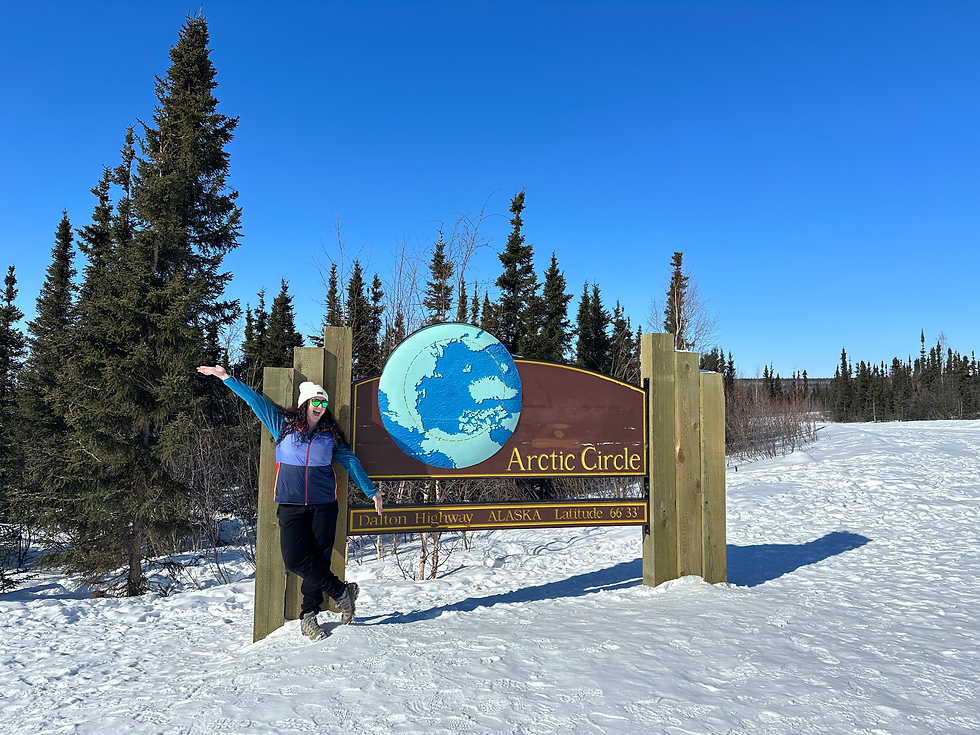
Most travelers begin in Fairbanks. From there, you can reach the Arctic Circle sign on the Dalton Highway by road tour or private vehicle, fly to a northern community, or join a guided Arctic exploration trip that continues into the Brooks Range.
A day trip can get you across the geographic line. A multi-day trip gives you time to understand the place.
For travelers who want a true Alaska Arctic vacation rather than a photo stop, our Arctic Basecamp expedition continues far beyond the sign to Galbraith Lake, north of Atigun Pass, where guests travel by dog team through the treeless Brooks Range.
What is the Arctic Circle—and what does it mean in Alaska?
The Arctic Circle is an imaginary line around the globe at approximately 66°33′ north latitude. North of it, the sun remains above the horizon for at least one full day in summer and below it for at least one full day in winter.
In Alaska, the line crosses a vast region shaped by the Yukon River, the Dalton Highway, the Brooks Range, Arctic tundra, and communities with deep cultural ties to the land. The Arctic is not empty. It is homeland, wildlife habitat, a working landscape, and one of the least developed regions in North America.
That matters when planning a trip to the Arctic. The goal should not simply be to “conquer” a latitude. It should be to travel with curiosity, humility, and enough time to notice where you are.

Fairbanks to the Arctic Circle: the main Alaska route
Fairbanks is the most common gateway for visiting the Arctic Circle in Alaska. The Dalton Highway runs north from near Fairbanks, crosses the Yukon River and Arctic Circle, passes Coldfoot and Wiseman, climbs through Atigun Pass, and continues across the North Slope, ending at Deadhorse near Prudhoe Bay and the Arctic Ocean.
The Fairbanks-to-Arctic-Circle-sign journey is roughly 200 road miles each way. It is a long day, and the Dalton is not an ordinary sightseeing highway. Services are limited, weather can change quickly, trucks have priority, and cell coverage is almost non existant. View map & directions here.
Your main options are:
Full-day drive with an experienced guide (15+ Hours). This is the simplest choice for most visitors who want to reach the sign and learn about the landscape along the way. Many companies offer bus tours with larger groups.
Self-drive (1-5 days). The more adventurous option with your own vehicle or a rental (if allowed), following an itinerary such as this Dalton Highway Road Trip from Fairbanks.
Join a multi-day Arctic trip. If your real goal is the Brooks Range, wildlife, dog sledding, northern lights viewing or time on the land, choose an itinerary designed around those experiences—not just the crossing.
On our Arctic Basecamp trip, the journey begins with a small-plane flight from Fairbanks to Coldfoot, followed by travel north on the Dalton Highway. Guests cross Atigun Pass before descending toward Galbraith Lake, with Gates of the Arctic to the west and the Arctic National Wildlife Refuge stretching across the eastern horizon.
When is the best time for Arctic Circle travel in Alaska?
The right time depends on what you hope to experience.
Spring: long light, snow travel, and a changing sky
Late winter and spring bring deep snow, strengthening daylight, and lingering twilight. This is the season for our Arctic Basecamp expedition because it combines reliable winter travel with long days. The sun has returned, but the mountains and tundra still hold winter. The road is arguably best driven at this time of year but one still needs to be prepared for extreme temperatures and avalanche danger in Atigun Pass.
Summer: midnight sun and road access
Summer is the most popular season for many Arctic Circle trips as it coincides with the larger tourism boom that comes with the midnight sun. The Dalton Highway is open, the tundra comes alive with plants and birds, and daylight continues around the clock north of the Circle. Mosquitoes can be intense, and rain may make backcountry travel wet and difficult. If there is no rain, expect dust on the graveled portions on the highway. There is a popular car wash on the right when re-entering Fairbanks that can be used to hose the Dalton Highway grit off your vehicle.
Autumn: color, migration, and early darkness
August to September. The most colorful time to visit. Tundra colors redden, berries are ripe, nights return, and aurora viewing becomes possible again. Conditions can shift from fall to winter with little warning. Be prepared for freezing temperatures and snow and increased traffic on the road from hunters searching for moose and caribou.
Winter: darkness, cold, and serious logistics
Winter offers extraordinary light and long nights, but it also demands experience, appropriate equipment, and conservative planning. This is not the season for improvising a remote road trip. Most of the drive will be in the dark. If the skies are clear, this is an opportunity to look for aurora. If the skies are cloudy, it will be a long, dark, drive.
If you are comparing Arctic Circle vacation packages, look beyond the month on the calendar. Ask how the itinerary uses the season, what weather contingencies are built in, and whether the operator provides the equipment and experience the environment requires.
What does an Alaska Arctic Circle vacation actually feel like?
The distances are difficult to understand until you are in them.
The road climbs. Trees thin and then disappear. A ptarmigan lifts from the willows. Caribou may appear as small moving marks along a ridge. Wind erases tracks. In spring, the light seems to stay in conversation with the mountains for hours.
That spaciousness is part of the gift, but it is also why guided travel matters. In remote Alaska, comfort and safety are created through preparation: warm shelter, dependable communication, experienced decision-making, thoughtful meals, good systems, and guides who are willing to change the plan when the land asks them to.
Our approach to Arctic travel is active and participatory. Guests on Arctic Basecamp do not simply sit in a sled. After completing a qualifying prep trip or prior expedition, each participant learns to guide a team of Siberian Huskies, care for the dogs, organize a sled, and take part in camp life. It is a closer relationship with the landscape—and a more honest understanding of what winter travel requires.
Exploring near the Arctic National Wildlife Refuge
The Arctic National Wildlife Refuge lies across northeastern Alaska, from the Brooks Range toward the Arctic coast. It is known for fragile tundra landscapes, river valleys, mountains, wetlands, and habitat used by caribou, polar bears, muskoxen, wolves, migratory birds, and many other species.
It is also important to be precise: Arctic Dog Adventure Co.’s basecamp is not inside the Refuge. It sits near Galbraith Lake, between Gates of the Arctic National Park and Preserve to the west and the Arctic National Wildlife Refuge to the east. From this part of the Brooks Range, the Refuge forms part of the broader eastern horizon and ecological story of the region.
What can you explore nearby?
The Brooks Range landscape. Treeless valleys, snow-covered passes, frozen waterways, and enormous views define this part of Alaska.
Wildlife country. Caribou, ptarmigan, muskox, the rare moose, wolves, bear, and other animals move through the region, but sightings are never guaranteed.
The Dalton Highway corridor. Sukakpak Mountain, Atigun Pass, and the transition from boreal forest to Arctic tundra make the route itself part of the experience.
The relationship between protected lands and living cultures. The Refuge is central to the life, culture, and food security of the Gwich’in people, who have stewarded and depended on this landscape for generations.
Travel near the Arctic National Wildlife Refuge should begin with respect. Learn whose homeland you are visiting. Give wildlife distance. Follow your guide’s instructions. Leave natural and cultural objects where they are. Avoid language that describes the Arctic as vacant or untouched by people.
A portion of every Arctic Basecamp booking supports Defend the Sacred Alaska, a grassroots organization working to protect the Refuge and the Gwich’in way of life.

Wildlife you may encounter above the Arctic Circle
Wildlife is one reason people dream about traveling to the Arctic, but the best trips do not treat animals as items on a checklist.
Depending on the season and location, travelers may see caribou, moose, Dall sheep, wolves, foxes, wolverine, porcupine, ptarmigan, raptors, and migratory birds. Along the Arctic coast, different habitats support marine mammals and polar bears, but those coastal experiences are distinct from an inland Brooks Range itinerary.
No ethical operator can promise a wild-animal sighting. What a good guide can do is help you read tracks, understand habitat, keep a safe distance, and recognize that not seeing an animal can also be evidence of how much space it has to move.
Arctic Circle Sign stop vs. a deeper Arctic exploration trip
Both experiences can be worthwhile, but they are not interchangeable.
Choose an Arctic Circle Sign trip if you:
Have only 1-2 days available from Fairbanks
Want to cross the latitude line and learn about the Dalton Highway
Prefer a road-based sightseeing experience
Are building a broader Interior Alaska itinerary
Choose a multi-day Arctic exploration trip if you:
Want meaningful time north of the Arctic Circle
Hope to experience the Brooks Range rather than only the roadside
Value small groups, skilled guides, and layered logistics
Want an active and/or immersive experience
Understand that weather and wilderness—not a rigid schedule—shape the day
When comparing Arctic vacation packages, ask exactly how many hours or days are spent north of the Circle, where guests sleep and use the toilet, how remote-area emergencies are managed, what physical participation is expected, and what prior experience is required.
What to pack for a trip to the Arctic
Your operator should provide a detailed, season-specific packing list. Avoid treating a generic Arctic checklist as sufficient.
For most Alaska Arctic trips, plan around:
A moisture-managing base layer such as merino wool (top and bottoms!)
Warm insulating layers (fleece or down jackets)
A waterproof outer layer
Insulated, waterproof boots appropriate to the season
Warm gloves or mittens, plus backups
Face, neck, and eye protection
Sun protection (sunglasses and sun hat) — especially when snow is on the ground
Personal medications in your carry-on/day pack
Water bottle (1+ litres)
Snacks
A flexible attitude
For the ADAC Arctic Basecamp, expedition clothing systems, heated shelter, sleeping equipment, dog gear, food, transportation, and emergency planning are all provided. Guests still need to arrive with the correct personal clothing and the experience required for participation.
You can read more about this in our What to Wear Dog Sledding in Alaska – Gear, Layering Tips & Cold Weather FAQs.
How to choose a responsible Arctic tour
An Arctic trip may look simple in photographs. Behind every safe, comfortable day should be a great deal of invisible work.
Before booking, ask:
Who are the guides, and what remote wilderness experience do they have? Here is our How We Keep You Safe standards.
Does the operator have the correct permits to operate their tour? The Bureau of Land Management in Alaska provides permits for commercial operators working outside the Gates of the Arctic National Park and Arctic Wildlife Refuge, as both have their own permit systems. We hold a BLM Special Recreation Permit #FF097332 as well as a National Park Service Commercial Use Authorization permit #2483 for Gates of the Arctic.
How does the company prepare guests before the trip? We give you a guest portal with everything you need to prep; insurance, packing list, pre/post trip accommodation suggestions, and more. Learn more on our Multiday Trip Planning Page.
What happens if weather changes the route or transportation? Here is our What Happens If Weather Affects Your Dog Sledding Tour?
How are animals cared for before, during, and after the season? Here is our How We Care for Our Sled Dogs at Arctic Dog Adventure Co.
Does the itinerary respect Indigenous people, lands, and knowledge? Lisbet, the owner and lead guide, holds a BA degree in Northern Studies and History from the University of Alaska Fairbanks and has decades of experience travelling in the North, learning from local people and communities.
How does the trip contribute to conservation or local communities? Our tours support Defend the Sacred Arctic, and you can learn more here.
Are the physical demands and prerequisites explained clearly? Here is our How Fit Should You Be for Dog Sledding? A Guide to Preparing to help you show up ready to mush.
For dog sledding trips, look closely at lifetime dog care, group size, guest instruction, and whether participation is designed around the dogs’ welfare. Our Siberian Huskies remain part of our family for life, and every itinerary is planned around their health, ability, and enthusiasm for the work.
Learn more about how we care for our sled dogs here.
Experience the Alaska Arctic by dog team
If you are looking for Arctic trips that go beyond the sign, our Arctic Basecamp mushing trip is a five-day spring expedition based near Galbraith Lake in the Brooks Range.
Guests fly from Fairbanks to Coldfoot, travel north across Atigun Pass, stay in heated Arctic Oven tents, and explore by dog team in a small group of max 6 people. Long spring days, snow-covered tundra, the possibility of aurora, and the quiet rhythm of working with huskies make this an Arctic Circle vacation unlike a conventional road tour.
This is an active remote-wilderness expedition, not an introductory dog sled ride. Participants must first complete an Arctic Prep Trip, a multi-day expedition with Arctic Dog Adventure Co., or demonstrate equivalent experience that has been approved before booking.
Explore the Arctic Basecamp trip to see current dates, requirements, and pricing.
For a guest’s perspective on the landscape, the dogs, camp life, and the care behind the logistics, read the traveler story: The Ultimate Arctic Dog Sledding Expedition.
You can also explore 5 Reasons Why You Should Visit the Alaskan Arctic for more inspiration and wildlife context.
Frequently asked questions about Arctic Circle travel in Alaska
Can you drive from Fairbanks to the Arctic Circle?
Yes. The Dalton Highway provides road access from the Fairbanks area to the Arctic Circle sign and continues north through the Brooks Range. The road is remote, services are limited, conditions can be demanding, and not many car rentals allow travel on the Dalton, so many visitors choose a guided tour.
How long does it take to get from Fairbanks to the Arctic Circle sign?
The sign is roughly 200 road miles from Fairbanks or at minimum, 10 hours roundtrip. A round trip is typically a full-day experience, with timing affected by road, weather, wildlife, and stops.
Is the Arctic Circle in Alaska worth visiting?
Yes—if the experience matches your expectations. Crossing the line is a memorable milestone, but the deeper value comes from learning about the land, taking time in the Yukon River drainage, and understanding the communities and wildlife connected to the region.
What is the best month to visit the Arctic Circle in Alaska?
Our favorite is early spring because it is best suited to snow-based Arctic exploration trips and increasingly long daylight. Autumn brings tundra color and returning darkness. Deep winter requires the most preparation. Summer is best for experiencing the midnight sun and mosquitos.
Can you see the Northern Lights above the Arctic Circle?
Yes, when the sky is dark and clear and auroral activity is present. Around the summer solstice, continuous daylight makes aurora viewing impossible. Spring and autumn can offer a balance of darkness and usable daylight, but sightings are never guaranteed.
Can tourists visit the Arctic National Wildlife Refuge?
Yes, but access is remote and the Refuge has no conventional visitor infrastructure comparable to a roadside national park. Independent travel requires serious backcountry planning. Many Alaska Arctic itineraries explore the wider Brooks Range or areas near the Refuge rather than entering it.
Is Arctic Basecamp inside the Arctic National Wildlife Refuge?
No. Arctic Dog Adventure Co.’s basecamp is near Galbraith Lake, positioned between Gates of the Arctic National Park and Preserve and the Arctic National Wildlife Refuge. The trip explores the surrounding Brooks Range landscape.
Do I need prior dog sledding experience for Arctic Basecamp?
Yes. Participants must have completed an Arctic Prep Trip or a multi-day expedition with Arctic Dog Adventure Co., or have equivalent experience approved before booking.
Ready to go beyond the Arctic Circle sign?
The line on the map is only the beginning. The Alaska Arctic asks for time, preparation, and attention—and gives back a scale of experience that is difficult to find anywhere else.
Explore the Arctic Basecamp expedition and discover what it means to travel north by dog team.


Comments